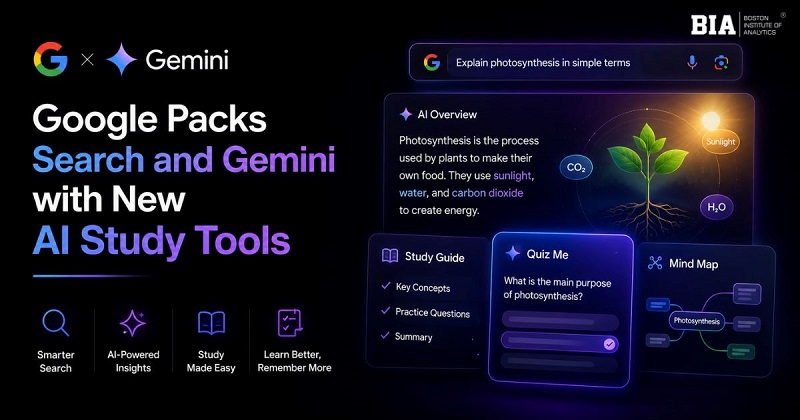
While back to school once involved new notebooks, pencils, and possibly backpacks, it seems like in 2026, back to school also involves entering an AI arms race in the quest for your attention. Indeed, this week, Google introduced a vast array of new study tools in both its Search and Gemini search engine and, quite honestly, it would be hard to be surprised by such news given the current speed at which AI is changing the educational landscape.
Google isn’t simply introducing a few study-related features it is entirely rethinking Search and Gemini as AI tools that are supposed to act as a proper study partner rather than just another search tool. It is quite obvious that the introduction of such tools is crucial for students but it is important to mention that it is also significant if you are taking an Artificial Intelligence course, since such developments provide a real-life example of what kind of systems the course is designed to teach you: multimodal learning systems, generative interfaces, agentic research assistants, and large-scale personalization. Now let’s take a closer look at what Google announced.
Google Adds AI Study Tools to Search and Gemini
As part of the expansion of its features for learning based on the use of AI, Google is developing study tools that will be available in Search and Gemini. These features are aimed at assisting students in exploring topics, grasping difficult concepts and organizing the material learned. Rather than just giving an answer, the AI-based features of Google may help in a more active learning process through posing follow-up questions.
Gemini will be able to assist students in breaking down complex topics, in making study materials, generating practice questions and simplifying explanations. Google Search is also enhancing its ability to help with information discovery by combining AI with its already existing search experience. It will make it possible to go beyond mere searching for information and start understanding it.
For those who are learning skills related to data science, artificial intelligence and technologies, these tools may become good learning companions. Boston Institute of Analytics advises using them in conjunction with practical projects, systematic study, and critical thinking.
The Announcement, in Plain Terms
There was a massive set of new study features added by Google within two of its most popular products – Search and the Gemini app, all of which were made specifically for students.
All-in-all, the company says that the update contains such things as AI-powered interactive graphics, 3D simulation, a separate student hub, as well as practice quizzes tailored to each individual user, and more.
This is Google’s most obvious hint to date that it wants Gemini to become the primary tool used by students, competing with such organizations as OpenAI and various education-focused start-ups including Knowt and Gauth, which have been creating such apps for some time already.
This is not just a single new feature release. This is a strategic move with numerous products being released simultaneously at the beginning of the fall semester.
The timing of the release was not a coincidence. Google clearly wanted to take advantage of the situation where students decide what tools they will use throughout the semester.
What’s Actually New?
There’s a lot packed into this release, so it helps to break it down by product.
In Google Search
Search is receiving some really cool improvements. Now, students are able to create interactive graphics and simulations on complicated subjects right through their search results. For instance, when a student searches for “pH scale”, the search results give him/her an AI Overview that contains an interactive visualization of the topic and explains the idea better than any simple webpage with a static text would.
When a student needs to know more about pH scale, he/she may formulate an additional question, and AI Mode will create a unique interactive visualization according to the specific query.
Also, Search is introducing some custom practice quizzes on subjects such as science, math, humanities, and foreign language courses to help the students test their knowledge without leaving the search.
Notebooks are also included in AI Mode to allow students to organize source materials lectures, syllabus, and web articles for each course or project and ask questions based on the materials from those notebooks. It is worth noting that notebooks integrate with the existing Gemini Notebook feature, so all of the work will not be fragmented anymore and will be performed in one unified environment.
In Google Lens
The next few weeks will bring a new interactive learning experience on Google Lens. You will have the ability to take a picture of a problem you’re solving, and Google Lens will tell you what the principle behind it is, where you could possibly go wrong, and how to solve it. The technology will basically transform your smartphone into a tutor that will be able to see your homework and answer your questions.
In Gemini
The biggest improvements will be seen in Gemini. Google’s new dedicated student hub allows people to integrate all learning functions of its tool into one place, where they will be able to create their study notebooks, make flashcards and take quizzes in a single app without having to look through several applications.
In addition to that, Deep Research is being integrated into Gemini Live, allowing students to start writing multi-step research reports via voice commands and then walk away while AI does all the work and notifies them once it is completed. Then, they can discuss it verbally, asking all the necessary questions aloud, not typing.
Moreover, the new feature called Guided Learning is added to the service and is aimed at helping people learn step-by-step via educational dialogue. It is not about finding a solution, but rather explaining it to people by clarifying the details, explaining the concepts and even providing illustrations and visualizations for that.
Another cool feature of Gemini is ability to create 3D simulations, which would help understand the complicated ideas in case they cannot be easily explained using texts and even diagrams.
The Incentive Layer
It’s not only through features that Google hopes to win over its students. It is offering a free year of Gemini Pro service to all eligible college students in the United States, and an offer where it gives a heavy discount on its YouTube Premium service. For international students, it’s one year of Google’s AI Plus service for free. In essence, it’s giving students access to these premium services for free in order to make them comfortable using Gemini all year round.
Why This Matters Beyond the Classroom?
While it could be considered yet another example of a simple product update, it is worth paying attention to the trend it reflects. Google seems to be banking on the idea that the future of search will be conversational, multimodal, and personalized, not simply a blue-links list anymore.
Features such as generative UI of AI Overviews, voice-based research in Gemini Live, and visual tutoring via Lens are all indicative of one and the same shift: an intelligent system capable of understanding the context across text, images, voice, and video and operating somewhat autonomously (for example, conducting research in the background).
That also means that Google is competing more directly now with OpenAI, which has recently released a ChatGPT version designed for teenagers specifically. Experts in the industry have no trouble calling it the beginning of a proper “features arms race” in the academic AI sector, and one can easily see the reason behind it whoever establishes themselves as a student’s main study aid is likely to retain it for a while after they graduate.
What This Means If You’re Studying AI Yourself?
This is precisely the sort of practical case study that brings the theory of artificial intelligence to life. As a person who is undertaking an Artificial Intelligence course, you are probably being introduced to theoretical issues such as multimodal models, retrieval augmented generation, agentic workflows, and personalization systems. The roll-out of the study tool by Google:
- Example of multimodality in practice. Combining text, visual graphics created using AI, voice, and camera data into one unified learning experience is a concrete example of multimodal AI which is not easy to grasp before seeing how such approach helps solve some particular problem, for instance, creating visual representation of pH scale instead of explaining it in text form.
- Agentic behaviour. A new Deep Research feature of Gemini Live, in which the AI system acts on its own and then informs the user of what it has done, is a concrete example of agentic AI system, which is capable of performing multi-step operations and doesn’t need constant control of the user.
- Dynamic generative UI. Generating interactive graphics and simulations depending on a follow-up question is a concrete example of how generative AI is developing from text generation to creating complete interfaces and dynamic content.
- Personalized results. Study notes, synced sources and personalized quizzes are examples of the ability of modern AI to tailor their outputs to a particular user’s situation.
Courses such as the one provided by the Boston Institute of Analytics will always gravitate towards application in exactly this way through practical examples from contemporary businesses as opposed to purely theoretical concepts because the speed with which AI operates means that a past lesson will quickly turn into a present-day practical function.
Understanding how a business such as Google puts these concepts to work and how others react to that shows them where the industry is really going, rather than where it came from.
How does Gemini help students study with Google’s new AI tools?
Gemini allows students to utilize Google’s new AI learning tools by offering a more interactive and personalized experience. Instead of supplying the answers to the questions, Gemini can assist the learners in investigating subjects, explaining difficult ideas, asking questions, and getting explanations that correspond to one’s level of comprehension. Therefore, it can be helpful for researching, revising, completing assignments, and developing an understanding of the subject.
By using Google’s AI learning tools, the students can be encouraged to engage in guided conversations. They can ask Gemini to simplify a complex concept, look at related ideas, or solve the task. The point is to use the AI as a learning partner, not only the answer provider.
When it comes to acquiring technology skills, the Boston Institute of Analytics emphasizes the importance of AI-assisted learning along with courses and project-based learning. In such a way, Gemini can support the learning process and project work can assist the learners to turn their knowledge into skills.
Can Google Gemini help students understand difficult concepts?
Indeed, Google Gemini is capable of helping students comprehend tough concepts through the provision of simpler explanations, examples, guidance in steps, and answering follow-up queries. A student may always ask Google Gemini to clarify a topic at different levels of difficulty to make the concept easy to understand.
Moreover, Google Gemini may be used for interactive learning since it allows students to keep asking questions till they have a better understanding of the subject. This is applicable to any technical subject, mathematics, sciences, programming, and many others.
It is important to remember that Boston Institute of Analytics states that AI solutions such as Gemini perform effectively in the combination with systematic learning, instructor guidance, and practical experience. Students are supposed to validate the information provided by AI in case of complicated or technical topics.
How can students use Google’s AI study tools for exam preparation?
The Google AI study tool can help the learner to review the hard subjects, simplify the hard topics, and generate practice questions. The Google Gemini AI can also help in the interactive learning process through enabling the learner to ask follow-up questions and to have them explained to him according to his level of understanding.
The students can also organize study sessions and summarize the topics, as well as revise through practice with the help of Google Gemini. Apart from memorizing the lessons, the learner can use the AI to understand the reasons behind a topic as well as identifying his gaps in knowledge. Nevertheless, learners need to check the information using textbooks and reliable sources.
At Boston Institute of Analytics, it is encouraged for the learners to combine their learning process with the use of artificial intelligence. Google AI can assist the learner in an interactive exam preparation, but practice and revision are still very essential for better performance.
Google Packs Search and Gemini with New AI Study Tools: FAQs
What are Google’s new AI study tools in Search and Gemini?
Google’s new AI study tools provide the interactive aspect of learning via Search and Gemini, allowing students to learn topics, get insights on difficult notions, and study with the help of AI explanations. Thanks to these changes, Google expands its potential of being useful for education and personalized learning. The Boston Institute of Analytics acknowledges that the need for AI literacy is increasing due to the growth of usage of intelligent technology by students and professionals.
How do Google AI study tools improve learning with Search and Gemini?
AI study tools offered by Google can make learning more interactive by dividing complicated subjects into explanations, guiding through the process of understanding, and allowing follow-up questions. Rather than simply providing an answer via searching, Google Search and Gemini can assist in exploring topics conversationally. Boston Institute of Analytics demonstrates how AI functions can complement traditional education and allow learners to explore concepts themselves.
What can students do with Google Gemini’s new AI study tools?
The Google Gemini AI study tools are able to assist learners in comprehending certain concepts, providing explanations, posing follow-up questions, and investigating different topics with the help of guided learning exercises. These functions aim at assisting active learning instead of providing a straightforward answer. Boston Institute of Analytics recommends learners to complement their AI tool usage with practice-based projects, professional training, and reliable learning resources.
How are Google Search AI study tools different from traditional search?
The conventional approach of Google Search was concentrated on finding relevant web pages for the users. On the other hand, the newly introduced AI study tools by Google Search can offer a more interactive way of investigation. It makes the search and concept investigation process more conversational. Boston Institute of Analytics considers this tendency to be one more example of the influence of artificial intelligence on information acquisition.
Can Google Gemini AI study tools help with difficult subjects?
Yes, Google’s Gemini AI study tools can enable learners to get help in tackling difficult topics through explanations, answers to further questions, and adjustments to the discussion based on the learner’s requirements. Nevertheless, the information generated by AI algorithms still needs to be compared to credible sources, especially for technical or academic content. The Boston Institute of Analytics highlights the importance of the combination of AI-assisted learning and proper training.
Why are Google’s new AI study tools important for AI education?
Google’s new AI study tools reveal how generative AI technology is developing beyond its content generation function and becoming personalized learning tools. They can help users form better research practices, become acquainted with new concepts, and interact with content in a more dynamic way. The Boston Institute of Analytics sees such a trend as a part of a larger AI-assisted learning movement.
How can Google AI study tools support students preparing for careers?
The Google AI study tools can assist career readiness in providing learners with technical know-how, researching unknown subjects, practicing problem-solving and acquiring basic knowledge. The Google AI study tools can be used most effectively together with real-world projects and professional development. Boston Institute of Analytics is interested in practical industry-specific education which can contribute to the skills development along with evolving AI.
What does Google’s AI study update mean for the future of learning?
The Google AI study tools update is a forecast of the future which will be characterized by personalized and interactive education delivered via AI tools. Students may find themselves using the conversational AI together with conventional courses, books, teachers and assignments. Boston Institute of Analytics sees great value in understanding how to use AI responsibly and effectively in the future.
The Bottom Line
The new Google study aids, whether for its Search or its Gemini tool, are not only about creating marketing buzz for the coming academic year. They actually mark a radical rethinking of how search engines and AI assistants work together: interactive visualization, voice-powered research, and guided learning as opposed to immediate answers that will bypass any actual comprehension.
It will mean more study options and more competition in platforms that can be put to good use by students, if the features themselves are used responsibly.
It will also mean a lot more for all other people, especially those who are learning about AI through their Artificial Intelligence course. The release is truly an interesting case study of where applied artificial intelligence is headed: multimodal, agentive, personalized, and integrated into people’s daily experience.
Monitoring such releases is not just an important industry practice. It is one of the most practical forms of education available, usually way ahead of anything a book would offer.
